
Use conditioner after shampooing and rinse it out as directed. If your ends still feel rough after they dry, try a mask at your next wash. Use it in place of conditioner if the label says you can. Keep both products on the lengths or ends if your roots get oily.1,2
In this guide
What to use after shampooing
How long to leave it on and when to rinse
- The American Academy of Dermatology recommends conditioner after each wash.1,2
- Conditioner reduces static and friction. Smoother strands are easier to comb and reflect light more evenly.3,4
- Proteins in conditioner can fill cracks and smooth split ends until the next wash.5,4
- The word “mask” tells you little about how to use it. Check the label for where to apply it and when to rinse.
What conditioner does to the hair
Hair carries a negative electrical charge that can increase after bleaching or other chemical treatments. Positively charged ingredients in conditioner help neutralize it, reducing static and frizz.3
Silicones and oils leave a thin film that helps strands slide past each other. You need less force to comb them, which can mean less breakage. A smoother surface also reflects more light.4,3
Shampoo washes away scalp oil. Hair stripped of oil can feel rough and tangle easily. Conditioner helps smooth it after washing.5
Conditioner, mask, and leave-in
| Product | When to use it | How long to leave it on | Where to apply it | If your roots get oily |
|---|---|---|---|---|
| Conditioner | After every wash1 | A few minutes, then rinse | The ends of fine or straight hair. Through the lengths of dry or curly hair1 | Away from the roots. For fine hair, use it on the ends only2 |
| Hair mask | When the ends stay dry or rough, if the label allows it | Often longer than conditioner. Follow the label | On the driest sections | Try it on its own in place of conditioner to see what changes |
| Leave-in | On damp hair after blotting with a towel6 | Leave it in | From the mid-lengths to the ends, away from the scalp6 | Use a light formula and the smallest amount that works6 |
The Kalliope’s mask label gives two options. On wet hair, leave it on for two to three minutes in place of conditioner. Before showering, leave it on for 30 minutes to several hours.9
When a mask might help
The ends feel rough after conditioning.
Use the mask in place of conditioner for one wash and check how the ends feel once they dry.
You color or chemically treat your hair.
Condition after every wash and space out chemical treatments.7
You swim in a pool often.
Rinse right after swimming. Then use a swimmers’ shampoo and a deep conditioner.7,2
You use a blow-dryer or flat iron often.
A leave-in on the lengths can help care for hair exposed to heat.6
Fine hair goes flat.
Use a little conditioner on the ends only. If your hair still feels heavy, try a lighter formula.2,6
Your hair is curly or very dry.
Apply conditioner through the lengths. For Black hair, the American Academy of Dermatology also suggests a warm oil treatment twice a month.1,8
How to apply conditioner or a mask
- Squeeze out excess water. Apply the product after your hair stops dripping so the water doesn’t dilute it as much.
- Start with a small amount. Add more if it hasn’t covered the lengths. Fine hair generally needs less.6
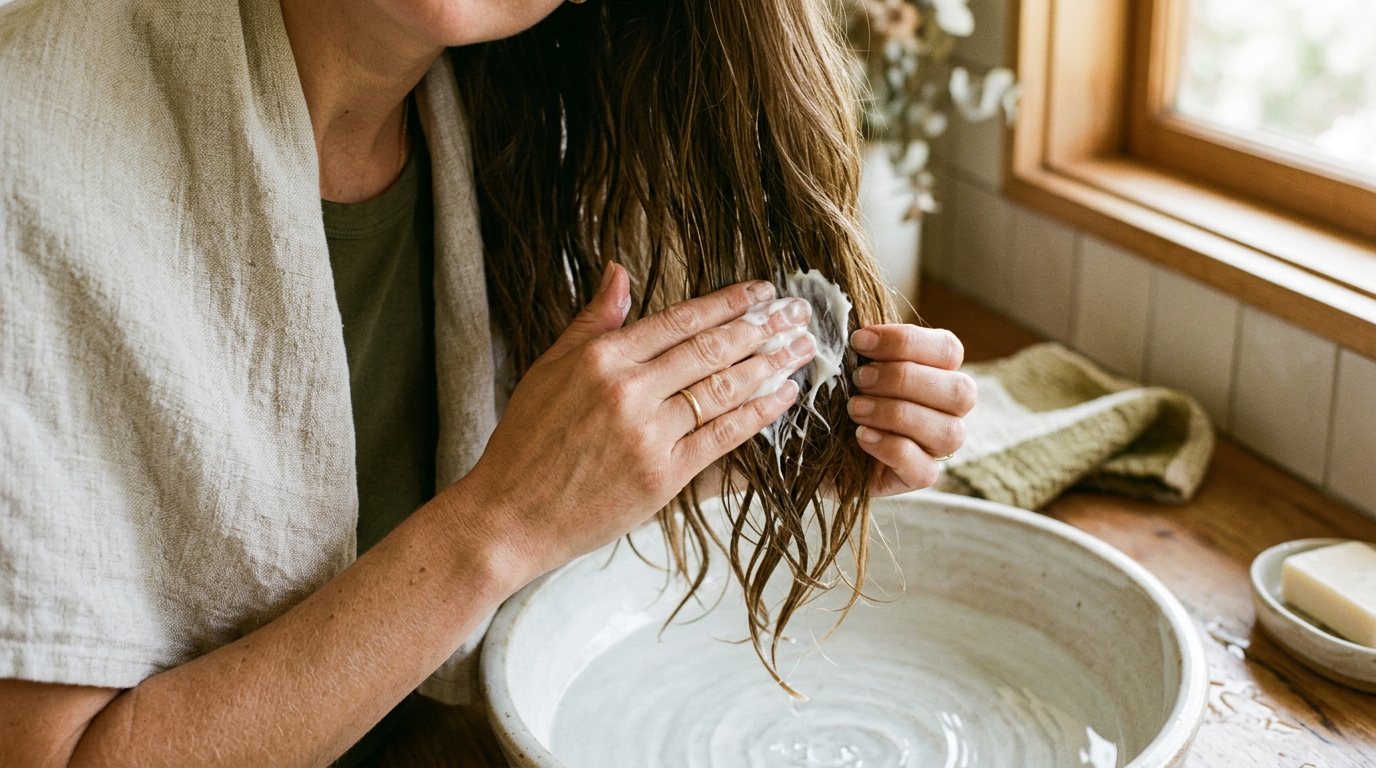
- Work it through the lengths and ends. Cover the ends well. They’re the oldest and most fragile part of the hair.8,1
- Follow the timing on the label. Conditioner often takes a few minutes. A mask may need longer.
- Detangle from the ends up. Use a wide-tooth comb or your fingers. Detangle thick curls with the product still in.1,4
- Rinse thoroughly. Residue near the roots can make hair look oily or feel heavy.3
Common claims about masks and conditioners
| Claim | What the evidence says | Finding |
|---|---|---|
| A mask permanently repairs damaged hair. | Hair outside the scalp is no longer living tissue. Products can smooth the surface and fill cracks until the next wash. The underlying damage remains.4,5 | Unsupported |
| Conditioning at every wash weighs hair down. | The American Academy of Dermatology recommends conditioning after shampooing. On fine hair, use it only on the ends to keep the roots from going flat.1,2 | Depends |
| Combining a mask and conditioner doubles the benefit. | We found no study testing that claim. Try a mask on its own if its label says it can replace conditioner. | No evidence found |
| Apply leave-in to the scalp for moisture. | Apply leave-in from the mid-lengths to the ends. Product that builds up on the scalp can irritate it.6 | Unsupported |
| Conditioner makes hair look shinier. | Conditioner smooths the surface. Certain silicones also increase shine.3,4 | Supported |
Related guides
Sources
The numbers in the text link to the sources below. We note when a study used lab samples or a small group of people, and when a company funded it.
- American Academy of Dermatology Association. Tips for healthy hair. aad.org/public/everyday-care/hair-scalp-care/hair/healthy-hair-tips
- American Academy of Dermatology. Dermatologists’ top tips for maintaining smooth, shiny hair. Press release, July 10, 2012. prnewswire.com/news-releases/dermatologists-top-tips-for-maintaining-smooth-shiny-hair-161907485.html
- Gavazzoni Dias MFR. Hair cosmetics: an overview. International Journal of Trichology. 2015;7(1):2–15. doi:10.4103/0974-7753.153450 pmc.ncbi.nlm.nih.gov/articles/PMC4387693
- Osório F, Tosti A. Hair weathering, part 2: clinical features, diagnosis, prevention, and treatment. Cosmetic Dermatology. 2011;24(12):555–559. cdn.mdedge.com/files/s3fs-public/Document/September-2017/024120555.pdf
- Draelos ZD. Essentials of hair care often neglected: hair cleansing. International Journal of Trichology. 2010;2(1):24–29. doi:10.4103/0974-7753.66909 pmc.ncbi.nlm.nih.gov/articles/PMC3002407
- American Academy of Dermatology Association. Dermatologists’ top tips for using leave-in conditioner. aad.org/public/everyday-care/hair-scalp-care/hair/leave-in-conditioner-tips
- American Academy of Dermatology Association. 10 hair care habits that can damage your hair. aad.org/public/everyday-care/hair-scalp-care/hair/habits-that-damage-hair
- American Academy of Dermatology Association. Black hair: Tips for everyday care. aad.org/public/everyday-care/hair-scalp-care/hair/care-african-american
- Panabeau. Directions for Kalliope’s Natural Conditioning Hair Mask.
Sources checked on . If scalp symptoms persist, see a dermatologist for an examination.
Frequently asked questions
Can I use a mask in place of conditioner?
Check the label. Some masks can replace regular conditioner and only need a few minutes on the hair.9
Do I apply a mask before or after shampooing?
Most go on after shampooing. Some can also go on before you shower. Follow the directions for the mask you use.9
Do I need leave-in if I already use conditioner?
Try leave-in if the lengths still tangle after you rinse out your conditioner. It can be especially helpful for colored, curly, long, dry, or frequently straightened hair.6
Why does my hair feel heavy after a mask?
You may have used too much, applied it too close to the roots, or left some behind when you rinsed. A thick layer of oil can also weigh hair down.3
How often should I use a hair mask?
Start with the schedule on the label. Try a mask when your ends still feel rough after conditioning.
Conditioner and mask in Hair Reset
The full Hair Reset contains a solid conditioner and a mask. The instructions show when to use the conditioner and when to try the mask on the ends.