
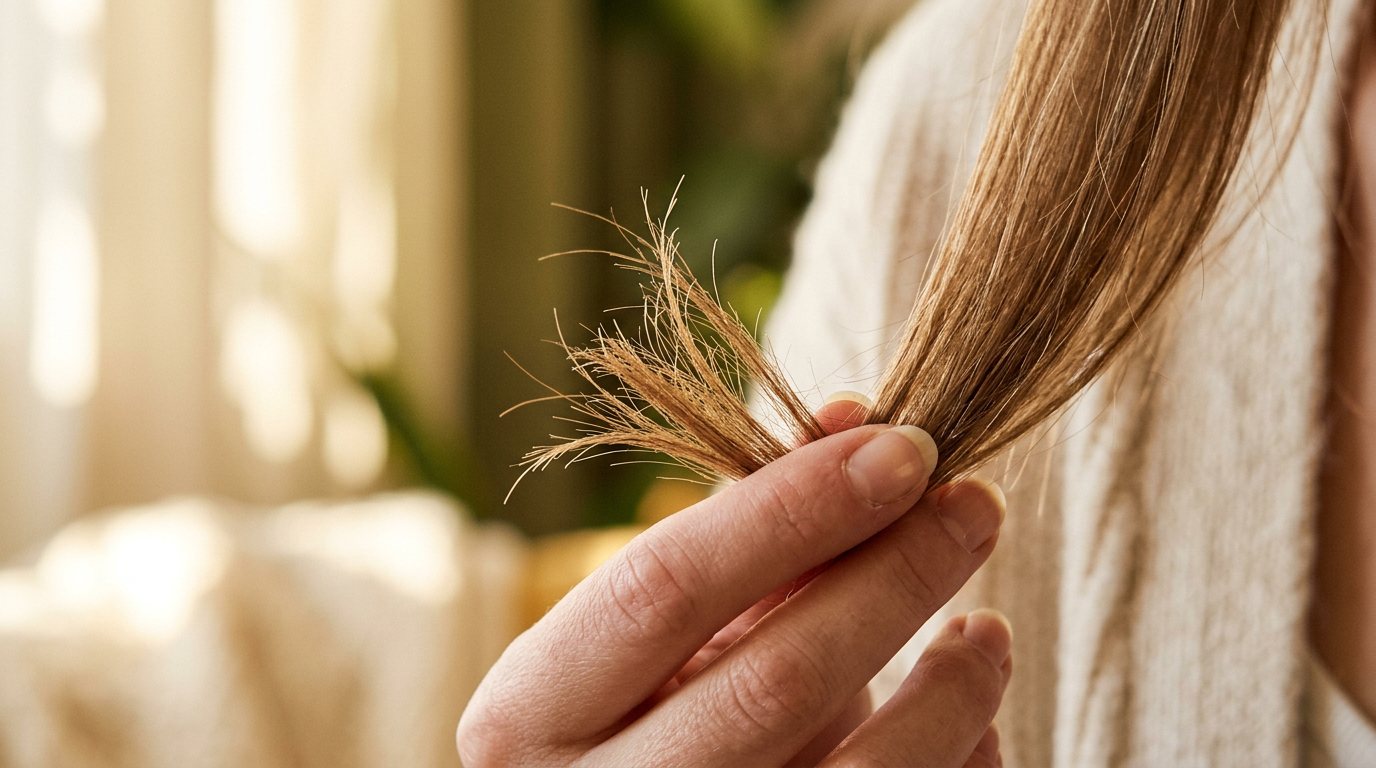
When the tip of a strand opens into two, you’re seeing a split end. It usually starts in the last two to three centimeters. A trim removes the split section. Conditioner can make it less visible until the next wash. Gentler combing and drying can help limit further damage.1,2
In this guide
What to do about split ends
Trimming and temporary smoothing
What makes hair split at the ends?
Dermatologists call split ends trichoptilosis. They can develop after repeated combing, heat, or exposure to sun or chlorine. When the outer layer lifts, it exposes the inside of the strand. The hair gets weaker and can split or break.1
The ends have been through more washes and combing than the hair near your roots. In a lab study, a hot dryer held close to the hair left cracks and holes in its outer layer.1,7
What helps with split ends
| Claim | What the evidence says | Finding |
|---|---|---|
| A trim removes split ends. | For damaged hair, a dermatology review advises cutting it a little shorter than usual, then trimming the ends regularly.1 | Supported |
| A serum or mask can seal split ends permanently. | Proteins can hold the two sides of the split together until the next wash. The damage to the strand remains.2,1 | Temporary effect |
| Conditioner can help prevent new split ends. | It helps strands slide past one another. You can comb through with less force, which helps reduce damage.1,6 | Supported |
| A trim makes hair grow faster. | Hair grows from follicles in the scalp. We found no study showing that cutting the ends changes how fast it grows. | No evidence found |
| Oil protects hair from damage. | In a company lab study, coconut oil reduced protein loss. Sunflower and mineral oil did not have the same effect.9 In a separate lab test described in a review, the fewest split ends formed on samples treated with Brazil nut oil or mineral oil.6 Both experiments used cut hair samples. | Some oils only |
How to reduce everyday damage
- Shampoo the scalp. Let the lather rinse through the lengths.4
- Condition after every wash. Cover the ends well.5,3
- Detangle from the ends up. Use your fingers or a wide-tooth comb. Avoid brushing wet hair. If your hair is straight, comb it when it’s almost dry.1,4
- Blot rather than rub. Use a towel or cotton T-shirt. When drying long hair, work from the ends toward the roots.5,1
- Use less heat. Stick with low or medium heat, use a heat protectant, and reach for the flat iron less often.5,4
- Wear a hat in the sun. It shields the scalp from UV light.1
- Trim damaged ends. Cut away splits and keep up with regular trims.1
For dry or frizzy ends, try leave-in from the mid-lengths down. A little oil, such as argan oil, may help.8 See when to use a mask or conditioner and how to dry your hair with less damage.
Signs that need a closer look
See a dermatologist if hair breaks close to your scalp, falls out at the root, or comes with an itchy scalp. Scratching can damage the strands further, so it’s worth finding the cause of the itch.1
Related guides
Sources
The numbers in the text link to the sources below. We note when a study used lab samples or a small group of people, and when a company funded it.
- Osório F, Tosti A. Hair weathering, part 2: clinical features, diagnosis, prevention, and treatment. Cosmetic Dermatology. 2011;24(12):555–559. cdn.mdedge.com/files/s3fs-public/Document/September-2017/024120555.pdf
- Draelos ZD. Essentials of hair care often neglected: hair cleansing. International Journal of Trichology. 2010;2(1):24–29. doi:10.4103/0974-7753.66909 pmc.ncbi.nlm.nih.gov/articles/PMC3002407
- American Academy of Dermatology Association. Black hair: Tips for everyday care. aad.org/public/everyday-care/hair-scalp-care/hair/care-african-american
- American Academy of Dermatology Association. 10 hair care habits that can damage your hair. aad.org/public/everyday-care/hair-scalp-care/hair/habits-that-damage-hair
- American Academy of Dermatology Association. Tips for healthy hair. aad.org/public/everyday-care/hair-scalp-care/hair/healthy-hair-tips
- Gavazzoni Dias MFR. Hair cosmetics: an overview. International Journal of Trichology. 2015;7(1):2–15. doi:10.4103/0974-7753.153450 pmc.ncbi.nlm.nih.gov/articles/PMC4387693
- Lee Y, Kim YD, Hyun HJ, Pi LQ, Jin X, Lee WS. Hair shaft damage from heat and drying time of hair dryer. Annals of Dermatology. 2011;23(4):455–462. doi:10.5021/ad.2011.23.4.455 pmc.ncbi.nlm.nih.gov/articles/PMC3229938
- American Academy of Dermatology Association. Dermatologists’ top tips for using leave-in conditioner. aad.org/public/everyday-care/hair-scalp-care/hair/leave-in-conditioner-tips
- Rele AS, Mohile RB. Effect of mineral oil, sunflower oil, and coconut oil on prevention of hair damage. Journal of Cosmetic Science. 2003, 54(2), 175–192. Company lab study. pubmed.ncbi.nlm.nih.gov/12715094
Sources checked on . If scalp symptoms persist, see a dermatologist for an examination.
Frequently asked questions
How often should I trim my ends?
A trim removes the split section. The dermatology review we cite advises regular trims without giving a number of weeks between them.1
Can a product seal split ends?
Proteins in some conditioners can hold a split together until the next wash.2
Why do I have split ends if I never color my hair?
Combing, heat, sun, seawater, chlorine, and friction can all wear down the ends.1
Care for the lengths and ends
Hair Reset contains a solid conditioner and a mask. The instructions show where to apply them if your ends still feel rough.